
The planner is not the problem on day one.
On day one, the notebook is clean. The dashboard is empty. The habit grid has no broken streaks. You can imagine the person you are about to become: organized, consistent, calm, and somehow always aware of the next important thing.
Day two still benefits from the fresh-start feeling.
Then an ordinary day arrives. Sleep is bad. Work expands. A task takes longer than expected. You miss one planned habit and move three tasks forward. The planner stops reflecting a future identity and starts documenting a gap between intention and reality.
That is the point where many systems become harder to open.
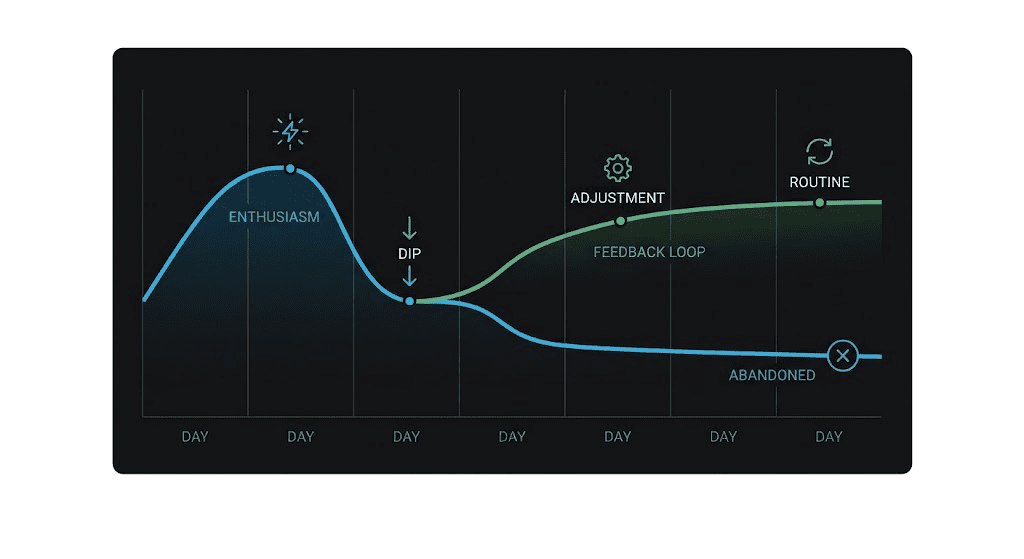
“Three days” is not a scientific deadline. Some people abandon a planner after one afternoon; others use one successfully for years. Here, day three is shorthand for the novelty cliff: the moment when the excitement of setting up a system disappears and the system has to earn its place in real life.
Most planners are excellent at recording intentions. Far fewer are designed to make progress visible, reduce the cost of returning, or create a satisfying response when the work is done.
That distinction explains why buying a more beautiful planner often restarts the same cycle without changing it.
The solution is not to cover every page in points and badges. It is to design a stronger feedback loop:
Choose a meaningful action → complete it → receive immediate feedback → see cumulative progress → know what to do next.
That is the core design behind LIFE RPG, where tasks become Quests, projects become Campaigns, life areas become Kingdoms, habits become Power Ups, and completed actions create XP and Coins in a shared Activity Log.
But this article is not an argument that everyone needs an RPG dashboard. It is an explanation of why planners are abandoned, what progress monitoring and motivation research actually suggest, and how to test the useful part of gamification without turning your life into a spreadsheet competition.
First: planner abandonment is not a character diagnosis
When a planner fails, the user is usually blamed.
The familiar explanations are personal:
- You were not disciplined enough.
- You chose goals that did not matter.
- You needed a better morning routine.
- You should have stayed consistent.
Sometimes those explanations contain truth. No tool can complete the work on someone’s behalf. But they ignore a basic design question:
What does the system ask from the user, and what does it give back?
A planner may ask someone to:
- capture every task;
- estimate dates;
- categorize work;
- review goals;
- migrate incomplete tasks;
- maintain a habit log;
- plan the next day;
- perform a weekly reset.
What does the planner provide in return?
Often, the answer is storage and order. Those are valuable, but they may not be enough to sustain a behavior that creates daily maintenance.
If checking a task only makes it disappear, completion removes information at the exact moment when the user needs evidence that effort is accumulating. If missed items remain visible indefinitely, the system preserves failure more clearly than progress.
The emotional balance becomes distorted:
- completed work vanishes;
- unfinished work survives;
- the planner becomes heavier over time;
- opening it produces guilt rather than direction.
That is not proof that the user is lazy. It may be evidence that the interface has become a negative feedback environment.
The “day-three cliff” is the point where novelty stops doing the work
A new system receives free motivation from novelty.
Choosing colors, building views, setting goals, and imagining a fresh routine all feel productive. The system is rewarding before it has helped with anything because setup itself creates momentum.
The problem appears when the user has to transition from designing the system to living inside it.
This transition creates three tests.
Test 1: Is the next action obvious?
If opening the planner reveals fifty tasks with equal visual weight, the system creates another decision instead of reducing one.
Test 2: Is logging easier than avoiding?
A two-minute habit should not require five properties, three relations, and a journal entry. When recording the behavior is almost as demanding as doing it, tracking becomes a second job.
Test 3: Does completion produce a useful response?
A checkbox is feedback, but it is usually brief. It says the task is done, then removes it from attention. A stronger system also shows what the action contributed to: a project, goal, life area, streak, or cumulative total.
Once novelty fades, these three properties determine whether the planner feels like support or administration.
Why planning alone does not create action
Planning is useful because it converts vague intentions into decisions. It can define what, when, and where. But a plan still depends on action and adjustment.
Research on goal setting and behavior change makes this distinction clear: setting an appropriate goal and creating an action plan can help transform intention into action, but neither can guarantee behavior change. Self-monitoring, social support, problem-solving, and other strategies may need to work alongside planning.Goal Setting and Action Planning for Health Behavior Change
A planner tends to focus heavily on the front of the loop:
- What do I want?
- What should I do?
- When will I do it?
A resilient system also pays attention to the back:
- Did it happen?
- What changed because it happened?
- What did I learn?
- What should happen next?
Without that back half, the planner keeps generating intentions while providing limited information about whether the system is working.
This is why a weekly plan can look excellent while the same tasks migrate forward repeatedly. The system is documenting promises but not helping the user interpret the gap between promise and behavior.
Visible progress is not decoration
One of the strongest reasons to track progress is that monitoring can support goal attainment.
A meta-analysis of experimental evidence on goal-progress monitoring found that interventions that increased monitoring frequency promoted goal attainment. Effects were larger when progress was physically recorded or reported.Does Monitoring Goal Progress Promote Goal Attainment?
This does not mean every activity needs a score. It means that converting progress from a vague feeling into a visible record can improve self-regulation.
Progress monitoring performs at least four jobs:
- It reveals discrepancy. You can compare the current state with the desired state.
- It supports adjustment. You can change effort, scope, or method when movement stalls.
- It preserves evidence. Completed actions remain visible instead of disappearing.
- It makes small wins legible. A large goal no longer looks unchanged after meaningful daily work.
Teresa Amabile and Steven Kramer’s work on the progress principle reached a related conclusion in the workplace. Their research, based on nearly 12,000 diary entries from 238 people, emphasized forward movement in meaningful work as a powerful contributor to motivation and positive inner work life.The Progress Principle — Harvard Business School
The key phrase is meaningful work.
Progress bars are not inherently motivating. A bar attached to an arbitrary number may become noise. The bar becomes useful when it represents something the user values and when the action feeding it is clear.
That is why LIFE RPG does not stop at a global XP total. A completed Quest can also feed a Kingdom such as Health, Work, Finance, Learning, or Relationships. The dashboard can show not only that effort occurred, but where it occurred.
Why normal checkboxes often feel emotionally flat
A checkbox has one state change: open to complete.
For simple lists, that is enough. The problem appears when the desired outcome is far away.
Consider these actions:
- complete one workout;
- study for thirty minutes;
- write one page;
- save a small amount of money;
- make one thoughtful call.
None transforms a life in isolation. The value comes from accumulation.
When the interface only checks the item and hides it, the user has to remember that accumulation mentally. On a difficult week, that memory is unreliable. The planner shows today’s unfinished work more clearly than the last month’s effort.
A stronger design adds a second response:
- the workout adds XP to Health;
- the study session levels a Skill;
- the writing Quest advances a Campaign;
- the saving action supports Finance;
- the call contributes to Relationships.
The real-world benefit is still delayed. The system provides a smaller immediate signal while waiting for it.
This is not about tricking the brain into believing a number is the goal. It is about preventing meaningful effort from becoming invisible.
What games understand about feedback
Well-designed games rarely leave the player uncertain about whether an action mattered.
They use:
- clear objectives;
- visible state changes;
- immediate response;
- calibrated challenge;
- progress toward a larger outcome;
- opportunities to recover after failure.
Productivity systems can borrow these mechanics without copying game aesthetics.
The most useful translation looks like this:
| Game design | Productivity design |
|---|---|
| Quest | Specific task |
| Campaign | Multi-step project |
| XP | Cumulative progress |
| Level | Milestone |
| Skill tree | Learning path |
| Currency | Reward budget |
| Character stats | Life-area indicators |
| Save point | Weekly review |
| Respawn/retry | Recovery protocol |
The important part is the relationship between action and response.
Gamification research is promising but not uniformly positive. A systematic review of gamification for health and well-being found evidence of positive impact, particularly for health behaviors, while also reporting mixed or neutral findings and methodological limitations.Gamification for Health and Wellbeing: A Systematic Review
So the responsible conclusion is not “gamification works.” It is:
Certain game-design elements can support engagement and behavior in some contexts, but results depend on the person, the behavior, and the design.
A shallow badge system may wear off with novelty. A controlling points system may undermine autonomy. A complicated reward economy may create more friction than it removes.
The planner still has to respect the user.
The motivation trap: rewards can support purpose or replace it
External rewards are not automatically helpful.
Self-Determination Theory distinguishes higher-quality autonomous motivation from controlled motivation driven mainly by pressure, approval, or rewards. It emphasizes autonomy, competence, and relatedness as needs that support sustained engagement.Self-Determination Theory overview
This suggests three rules for gamifying productivity.
Rule 1: The user chooses the game
Kingdoms, Quests, XP values, and rewards should reflect personal priorities. A system imposed from outside can turn points into another form of control.
Rule 2: Progress should support competence
A level should show growing capability or repeated effort, not create a false hierarchy of human worth.
Rule 3: Rewards should not replace meaning
The Coin is a bridge to immediate feedback. The Health Kingdom still matters because health matters. The Campaign still matters because its outcome matters.
If someone begins choosing low-value tasks only because they produce more XP, the scoring rules need adjustment. The game should serve the life, not become the life.
The five missing loops in most planners
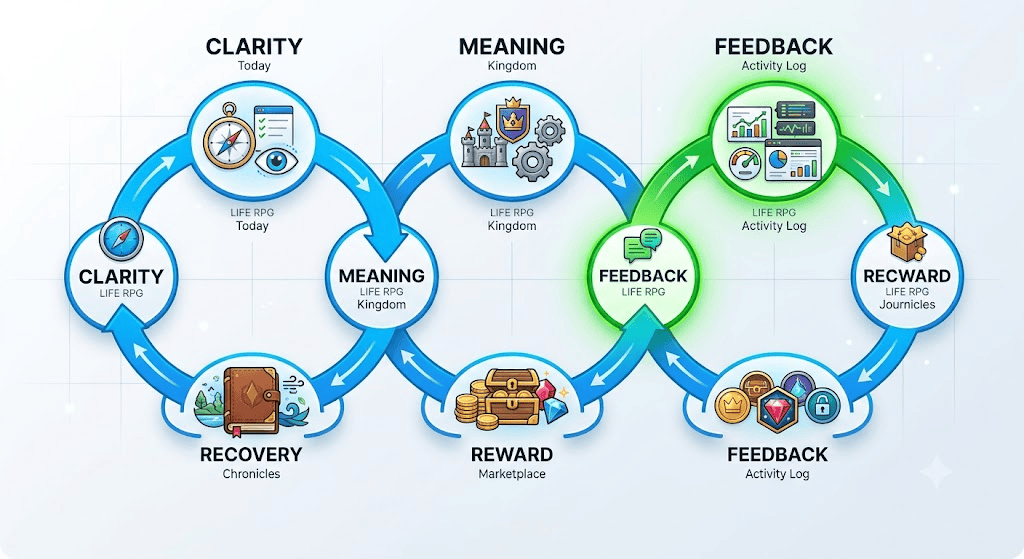
A planner is more likely to survive when it contains five connected loops.
1. The clarity loop
Question: What matters now?
Use a Today view with a realistic number of actions. Separate the inbox from the daily surface. Do not show every future obligation every morning.
In LIFE RPG, this is the QUEST BOARD’s Today view. The master database may be deep; the daily decision should be small.
2. The meaning loop
Question: Why does this action matter?
Connect each important Quest to a Campaign or Kingdom. “Draft product FAQ” advances the Launch Campaign. “Walk after lunch” supports Health.
3. The feedback loop
Question: What changed when I acted?
Record the completion in an Activity Log. Add XP, Coins, progress, or a clear status change. Keep the response immediate and understandable.
4. The reward loop
Question: Is there a satisfying near-term payoff?
Coins can be exchanged for self-defined rewards in a Marketplace. Rewards should be desirable, reachable, and never required for basic care.
5. The recovery loop
Question: What happens after I miss?
A weekly review, Chronicle entry, or Shadow Realm record should help identify friction and choose a smaller re-entry Quest. The system should not make one missed day equivalent to total failure.
Most planners contain the clarity loop. The systems that survive tend to support more of the other four.
How LIFE RPG changes the planner relationship
LIFE RPG is still a planner. It does not perform the workout, write the page, or make the difficult call.
The difference is what happens around those actions.
Tasks become Quests
The name is memorable, but the functional change matters more: a Quest can belong to a Campaign, feed a Kingdom, carry XP, and create an Activity record.
Projects become Campaigns
A Campaign has an outcome, related Quests, progress, and a completion bonus. It prevents large goals from living as vague labels.
Life areas become Kingdoms
Health, Work, Finance, Learning, and Relationships can display their own progress. This makes imbalance visible.
Habits become Power Ups
Repeated behaviors receive a minimum version, frequency, streak, XP, and a related Kingdom. The goal is to make check-in fast and repetition visible.
Bad habits enter the Shadow Realm
Avoidance and recurring triggers are tracked for awareness and recovery rather than hidden from an aspirational dashboard.
Completion enters the Activity Log
The Activity Log is the shared ledger. Quests, habits, workouts, Campaigns, and Goals can produce one consistent record of XP and Coins.
Coins enter the Marketplace
The reward currency creates a near-term consequence for effort. The user decides what is genuinely rewarding.
Reflection enters Chronicles
Daily notes and weekly reviews preserve context. A system cannot learn from behavior if it only counts completion.
The result is not a more dramatic to-do list. It is a life OS in which actions, progress, rewards, and reflection are connected.
Why recovery matters more than a perfect streak
Many planner systems are built for uninterrupted consistency.
The habit grid looks beautiful while every box is filled. The motivational language assumes the user will “never miss twice.” The visual design becomes less satisfying after a gap.
But interruption is normal.
Travel, illness, deadlines, caregiving, stress, and ordinary fatigue change context. Wendy Wood’s work on habits emphasizes that behavior is influenced by stable cues, friction, and environment—not only by willpower. In an interview with Behavioral Scientist, Wood described habits as learning mechanisms shaped by repetition and reward, and noted that simple habits may take two to three months to become automatic rather than a universal twenty-one days.Wendy Wood on habits and context
A planner that treats interruption as failure becomes hardest to use when support is most needed.
A better recovery protocol is:
- Name what changed.
- Reduce the next action.
- Restore the cue or choose a new one.
- Record the return.
- Review the rule that created friction.
In LIFE RPG terms, a difficult period is not the end of the character. It is information for the Shadow Realm and Chronicles, followed by a smaller Quest.
Build a seven-day reward-loop experiment
You can test this idea without buying a template or building a complete life OS.
Step 1: Choose one Kingdom
Pick one area that matters now: Health, Work, Learning, or Relationships.
Step 2: Choose three repeatable Quests
Examples:
- Walk for twenty minutes.
- Complete one focused work block.
- Study for twenty-five minutes.
Each Quest must have a clear finish line.
Step 3: Assign simple XP
Use one scale:
- small action: 5 XP;
- standard action: 10 XP;
- difficult action: 20 XP.
Do not spend time debating perfect values.
Step 4: Set one milestone
At 100 XP, reach Level 2. The threshold only needs to be understandable.
Step 5: Add one reward
Earn 50 Coins for a small reward you actually want. Keep Coins separate from XP so spending does not erase progress.
Step 6: Make completion visible
Use a Notion table, spreadsheet, or paper log. Record each completion immediately.
Step 7: Review the system after seven days
Ask:
- Did visible progress make returning easier?
- Were Quests too large?
- Did the reward matter?
- Did logging create friction?
- Did I choose meaningful actions or easy XP?
- What happened after a missed day?
Do not judge the experiment only by completion rate. Judge whether the design helped you understand and repeat the behavior.
When a plain planner is the better choice
Gamification is not automatically an upgrade.
Use a plain planner if:
- checking tasks already feels satisfying;
- your workload is simple and stable;
- points create distraction;
- you dislike quantifying personal life;
- maintaining the reward rules feels heavier than the benefit;
- a calendar and short list already produce reliable action.
The best productivity system is not the one with the most mechanics. It is the one that provides enough structure and feedback without becoming another obligation.
For some people, that is paper. For others, it is a simple task app. For people who respond strongly to visible progress, identity, challenges, and rewards, a gamified Notion planner may be a better fit.
A practical audit for the planner you already own
Before replacing your system, score it from 0 to 2 on each question:
- Clarity: Can I see the next meaningful action within ten seconds?
- Friction: Can I capture and complete an item quickly?
- Meaning: Are tasks connected to projects, goals, or life areas?
- Feedback: Does completion create visible progress?
- History: Can I see what I have accomplished?
- Reward: Is there a near-term payoff for sustained effort?
- Recovery: Is returning after a gap easy?
- Review: Does the system help me adjust rather than only record?
- Mobile use: Does the daily workflow work on the device I actually use?
- Maintenance: Can I keep it clean in fifteen minutes a week?
A low score does not mean the planner is bad. It shows which function may be missing.
Do not rebuild everything. Fix the lowest useful score first.
The real goal is returnability
Productivity systems are often judged by how organized they look or how much they can store.
A more useful measure is returnability:
After a bad day, does the system make it easier to return?
A returnable planner:
- does not confront the user with every overdue item at once;
- preserves completed work;
- shows one next action;
- allows goals to be resized;
- treats misses as information;
- restores feedback quickly.
This is why the reward loop matters. It is not there to make every task entertaining. It is there to give effort a response and make tomorrow’s return feel worthwhile.
The planner that survives is rarely the one that demands perfect discipline. It is the one designed for the moment discipline is low.
Frequently asked questions
Why do I stop using planners after a few days?
Common reasons include fading novelty, excessive maintenance, unclear priorities, lack of visible progress, and guilt created by accumulated unfinished work. The right fix depends on which friction is present; a new planner will not help if the loop remains the same.
Is “day three” a proven abandonment deadline?
No. It is a memorable way to describe the novelty cliff, not a universal scientific rule. Abandonment timing varies widely by person, tool, context, and behavior.
Does gamification improve productivity?
It can support engagement, progress visibility, and feedback in some settings, but evidence is mixed and context-dependent. Meaningful goals, autonomy, low friction, and good recovery design matter more than adding points alone.
What is a productivity reward loop?
A reward loop connects a meaningful action with an immediate response—such as visible progress, XP, a milestone, or a redeemable Coin—while keeping the action tied to a larger goal.
Can I build a gamified planner in Notion?
Yes. The minimum version needs a Quests database, a related Kingdom or goal, an XP value, and a progress summary. A full system can add Campaigns, habits, an Activity Log, Coins, rewards, and review pages.
Should I use negative points for missed tasks?
Usually not. Negative points can turn tracking into punishment and make users hide or avoid the system. Track misses for learning, resize the next action, and reward returning.
Do I need to be a gamer to use LIFE RPG?
No. The practical mechanics are clear actions, progress monitoring, milestones, and rewards. The RPG language makes the structure memorable, but the underlying system is ordinary life planning.
Test the feedback loop first
Before buying another planner, test the seven-day experiment in this article.
If visible progress and a small reward make you more willing to return, explore how the full loop works inside the LIFE RPG free preview: HERO HUB, QUEST BOARD, Kingdoms, XP, Coins, and the Activity Log.
Explore the free preview: notiondone.com/product/life-rpg
The goal is not to make life feel like a game every minute. It is to build a system that notices when you show up.